Screening recommendations for Boxer JKD
|
At this time the simplest, most economical and sensitive screen for identifying any developing kidney failure is the urine specific gravity screen (USG) The procedure is described here. It can be done by either your vet while you wait, or breeders can purchase refractometer for their own personal use. A refractometer can be readily purchased online or from your vet clinic. Dogs that consistently produce dilute urine less than 1.030 shpuld be investigated further |
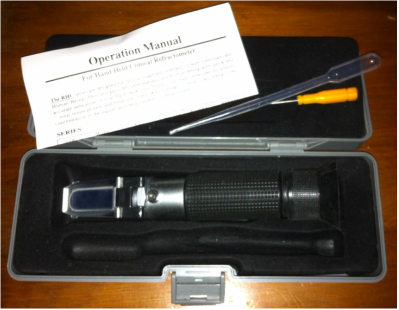
A refractometer can be purchased cheaply from any veterinary surgery
|
USGs have two applications at this time:
a. screening puppies prior to sale and as a breeder follow up every 6 months
b. screening adults and bitches prior to breeding
Puppy screening:
While USG screening is not applicable for baby puppies which have immature kidneys that have yet to function like adult kidneys, it can be tried after 8 weeks of age and should give valid results in puppies over 3 month old of age.
It is recommended to attempt to carry out USG testing on all pups before sale. The breeder should make arrangements for all puppies sold to be re-screened every 6 months thereafter until they are 2 or 3 years of age. All records for the whole litter should be kept. Anything abnormal should be reported.
Puppies with consistently low USG values should be investigated further using different diagnostic blood and urine tests, and the results reported.
All puppy owners should be asked to keep a careful watch for any urinary tract infections (UTI) that might develop, this may be the first sign of the symptoms Boxer JKD developing in the puppy, together with difficulty in house training and excessive drinking.
Adult screening:
Adults can be screened at any age but it is advisable that all bitches should be screened before breeding, as pregnancy may trigger onset of the disease symptoms in what were 'sub-clinical' cases. All adults with consistently low USGs less than 1.030 should be investigated further with diagnostic tests, and reported.
A careful watch for urinary tract infections (UTI) is advised as this may be a first sign of JKD.
The SDMA test is a useful screen to check for early signs of kidney disease SDMA of less than <18 need further investigation.
a. screening puppies prior to sale and as a breeder follow up every 6 months
b. screening adults and bitches prior to breeding
Puppy screening:
While USG screening is not applicable for baby puppies which have immature kidneys that have yet to function like adult kidneys, it can be tried after 8 weeks of age and should give valid results in puppies over 3 month old of age.
It is recommended to attempt to carry out USG testing on all pups before sale. The breeder should make arrangements for all puppies sold to be re-screened every 6 months thereafter until they are 2 or 3 years of age. All records for the whole litter should be kept. Anything abnormal should be reported.
Puppies with consistently low USG values should be investigated further using different diagnostic blood and urine tests, and the results reported.
All puppy owners should be asked to keep a careful watch for any urinary tract infections (UTI) that might develop, this may be the first sign of the symptoms Boxer JKD developing in the puppy, together with difficulty in house training and excessive drinking.
Adult screening:
Adults can be screened at any age but it is advisable that all bitches should be screened before breeding, as pregnancy may trigger onset of the disease symptoms in what were 'sub-clinical' cases. All adults with consistently low USGs less than 1.030 should be investigated further with diagnostic tests, and reported.
A careful watch for urinary tract infections (UTI) is advised as this may be a first sign of JKD.
The SDMA test is a useful screen to check for early signs of kidney disease SDMA of less than <18 need further investigation.
|
|
|
|